Monday, March 19, 2012

Deaf Blind Interpreting

Recently I have been volunteering to do deaf-blind interpreting which is very different . One thing I had to learn is that each Deaf-Blind (DB) person's needs is different. There could be a person who is Deaf but gradually lost their sight, or gradually losing their sight; there could be a person who is Blind but gradually losing their hearing; or a person who has recently become deaf and blind. The combinations can go on and on but the point is that working with a DB person requires the ability to be flexible.

For the Registry of Interpreters' standard of Deaf-Blind interpreting please follow this link: www.rid.org/UserFiles/File/pdfs/Standard_Practice_Papers/Drafts_June_2006/Deaf-Blind_SPP(1).pdf.

For now though, I would like to share my recent experiences working with one particular DB person. This person is tactile. According to our industry's standard referenced above, tactile means, "�� sign language received by sense of touch with one or two hands (tactile) �� fingerspelling received by sense of touch (tactile)." I will use the pseudo name, Francesca.

Attention getting with Francesca is little different. Unlike deaf individuals that may prefer a tap on the shoulder, with Francesca, I lightly bump my hand with hers to indicate, "Hey, there, I'm here." Most times Francesca "answers" by signing, "Who?" Whereas a Deaf person could see "Who?", a DB person can not see "Who;" thereby the need to CONSISTENTLY identify individuals when they are "speaking/signing." I answer by placing my dominant hand under her left hand and articulate my sign name. Then cordialities are exchanged.

The discourse is preceded with an ASL song. As the audience stands to "sing" the ASL song, Francesca stands but turns to face me. She has made the decision to use both of her hands so that she can "track" what I am signing. This means she will place her hands on top of mine as I am copying the ASL song being played from a DVD. This can be tricky because there are signs and grammar that are on the face or head that a DB person cannot see. There is a constant consideration as to how this will be executed (what linguistic equivalent can be used?) Negations and emotions are a few examples. Vigilance is key.

Once the song is finished, the audience takes their seats and now its time for the discourse. Francesca likes to know the name of the presenter, where he is from, and what medium is he using (iPad or paper outline, or pictures). One thing that impresses me in this process is that Francesca is able to ascertain if the speaker is new to Sign language or not.

At one time in her life, Francesca was able to see enough and was an art major. As her sight deteriorated, things changed. Knowing this helps me know that when pictures are used during the ASL songs or the discourse, I can describe color to Francesca and she can paint a similar thought image in her mind's eye.

At another meeting, the logistics are a little different than the discourse explained above. The reason being this meeting is now opened to the public for their comments. The discourse has a one directional flow of information. But when the public is involved other consumer needs come into play. For example, Francesca likes and demands (as consumers we all demand or "order" what we want, right?) knowing who is speaking and what general direction they are sitting. If there is a change in audience seating, this needs to be conveyed.

Francesca has a hearing dog. Similar to a seeing eye dog, this dog leads her around. So unlike SSP, when I am working with Francesca, I do not have to lead her around. Her dog does that job. There are times though when Francesca wants to meet a specific person. Maybe I have informed her during the meeting that there are visitors or new faces that are not familiar. Sometimes she will ask me or others to lead her to such ones.

At a party a spotted Francesca dancing with her non-deaf husband who is uber fluent is ASL. She was doing the electric slide.

This woman, her husband, and her dog have gone and done so many things. In fact, she has lived in Honduras and there too, she was very independent!

Another amazing thing is when we go to Starbucks or the like, Francesca doesn't depend on others to order for her. She has a machine that she carries cross-body (like a messenger style bag) that she uses to receive emails, text messages, and she uses gps. I don't know the name of the device but it sends and receives signals from her personal devices and converts those signals to a signal to this device that will help her "read" messages. This hip device converts the signals to Braille. Her hip device uses pins that automatically convert to Braille and it scrolls across. I am sure I am not explaining this awesome experience clearly but believe me it is jaw dropping.

There are so many other nuances that just floor me working with Francesca. I am biased. Yes, working with Francesca is one of my secret joys. But I need to experience others. What are their preferences? How do I work with each one of them? One strong resource if you are interested is Ms. Rhonda Jacobs. Check RID website for her contact info and she can fill you in and get you connected to yet another spectrum of Deaf culture.

Until later,
Keep it Simple


Wednesday, January 4, 2012

Sign Language Interpreter--What to expect?

Using a Sign Language interpreter may seem to be an awkward experience. "What do I expect?" "What is expected of me?" "Do I need to speak slower than usual?" "What do I do?" This blog will answer some basic questions.

First of all, professional standard is to have the interpreter arrive approx 10-15 mins prior to the assignment. This time is for the interpreter to prepare for the assignment (spelling of names, obtaining an agenda, locating the room of the event, etc).

Professional standard dictates the interpreter to wear a solid, color of clothing that contrasts with their skin color. The reason is that the clothing acts as a backdrop for the visual communication.

The Standard Practice Paper, Professional Sign Language Interpreting states, "...the interpreter sits in proximity to the.... speaker to allow the deaf person to see the interpreter as well as the facial and body expressions of the English speaker." This is a very different than spoken language interpreters/translators.

During the interpreting process, there is no need to exaggerate or slow down a person's normal way of speaking. This is a misnomer. There are times when the interpreter may ask for a restatement of what was said; but again, in most circumstances, the speaker does not need to change the way they normally speak.

Because of the introduction of a third person (the interpreter), it is very easy to slip into speaking ABOUT the deaf person in third person. "Please tell HIM that we are about to start the interview." "Can you tell HER that we will refund her money." These can be avoided by looking the deaf individual in the eye (as opposed to looking at the interpreter) and addressing the person directly ("Mr. Jones, we are about to start the interview," "Jane, we will have to refund your money.")

This interaction is going through an interpreted process. You may have to give some time after asking a question or before conclude your interactions. This is to assure the process of interpreting/translating has been accomplished.

Many interpreters are Generalist, but we also have interpreters that specialize in: medical, legal, performing (concerts, plays, etc.), educational, and conventions/conferences.

What is put forth in this post is not the end all or be all. This is not "Working With an Interpreter 101." This post is not to be a standard. This post is only to give an idea of what may be expected when working with professional and/or certified interpreters.

For more information on our professional entity, please go to www.rid.org. This is the Registry of Interpreters for the Deaf website. Here you can find our Standard Practice Papers and even locate Sign Language interpreters in your area.

Please feel free to contact me at 301.KIS.3433 0r 301.547.3433 for more info. You can also send an email to kisinterpreting@gmail.com.


Next blog: What if the person is deaf-blind?

Thank you!


Friday, December 17, 2010

Meylin and Damen's wedding 2010--Trilingual Wedding


Beautiful wedding!

Congrats!

You can't tell from the pictures, but this was a trilingual wedding. The wedding discourse was given in English, translated to Spanish and American Sign Language. The bride and groom exchanged vows that were in ASL and voice-interpreted to English.

The bride's family members all remarked how impressed there were to see the accommodations made to meet everyone's needs. This access allowed all to participate in such a momentous occasion of their loved ones.

Watching the Spanish interpretation reminded one of UN meetings; the interpreter wearing headphones, interpreting into a microphone or a device, and those receiving the interpretation wearing earpieces. Very well coordinated effort. And all was at no charge to the couple!!


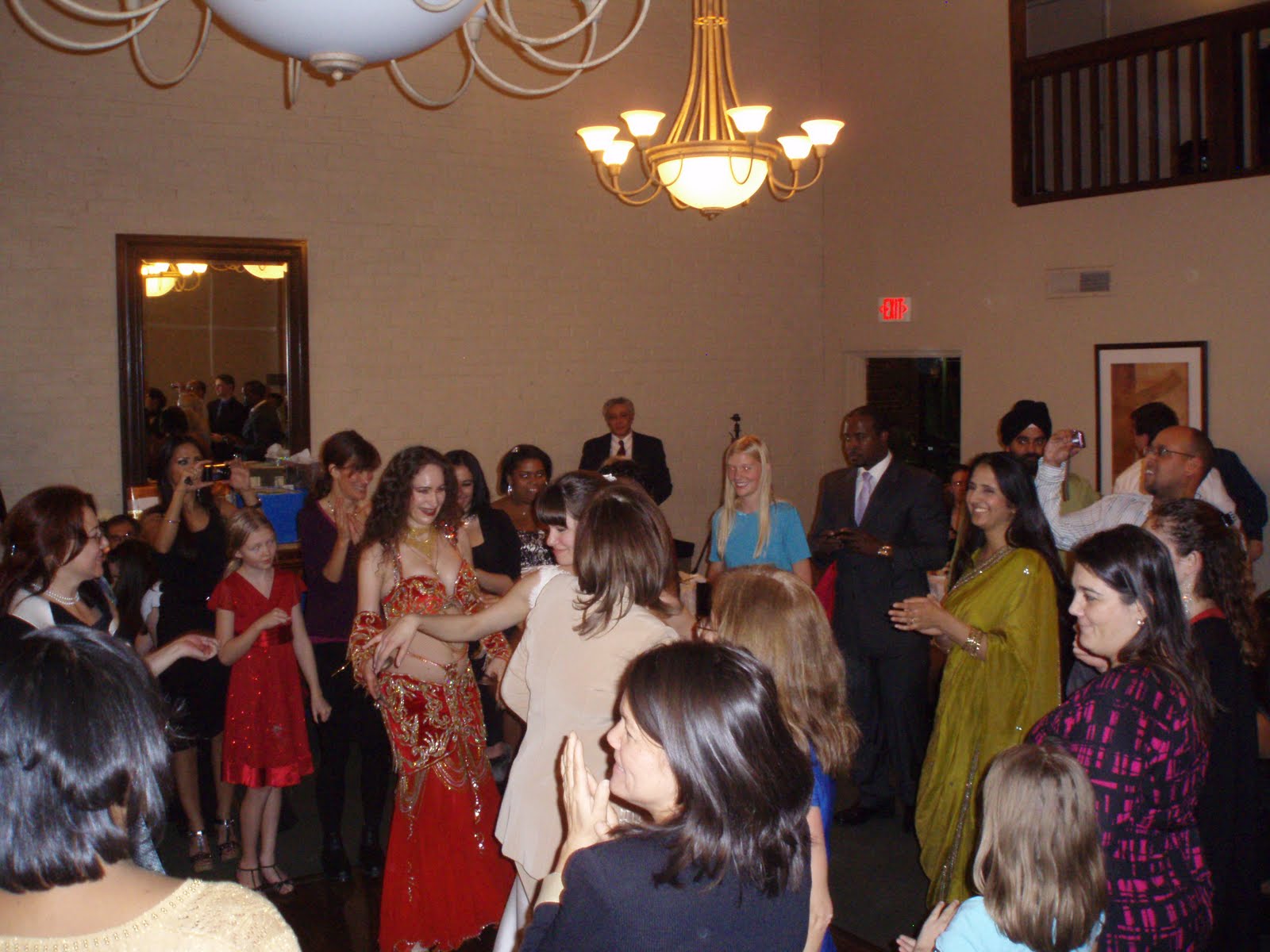
Heba and Dave's wedding celebration Dec, 2010--Multi-Cultural Wedding


WOW! What an awesome celebration and a privilege to be invited!

I don't think that I have pictures that show all of the attendees. It was such diverse sea of people, cultures, and backgrounds. Wonderful time!

There were many Gallaudet students and staff in attendance. Many of them enjoyed the belly dancing instruction as shown above. This wedding was very rich with multiple cultures.

Thanks, Heba and Dave!

Tuesday, May 11, 2010

What About Being QUAD Lingual and Deaf??


Saturday afternoon, My husband and I decided to enjoy the pollen tempest and take a nice brisk walk via the footpath over? under (maybe around?) the Woodrow Wilson Bridge from National Harbor.

Such a clear day, perfect for signing. I wondered if we would see any members of the Deaf community? Yes, I am a NERDA (Not Even Related to a Deaf Adult) Plus, it just felt good to be outdoors. It was sunny and bright (nothing casting a shadow). Beautiful day despite being extremely windy.

"Over there......,""Where?" My husband asks. With everything blowing around, maybe I'm seeing things. My "saving-my-energy-for -the-trail walk" turned into a brisk walk to....Why, yes! Sign Language!!!! Yippie!!!!

Well, as it turns out, all of the Deaf we met were from Saudi Arabia and there was a Hard of Hearing woman from Iran. So how did we communicate since ASL is AMERICAN Sign Language and is not universal? These individuals are QUAD linguist. They are fluent in their country's spoken language, their country's sign language, ASL, and English. One person told me that he wanted to learn Spanish!!!! So we were able to converse using ASL. WHOA!!! How many Americans can say that we know more than English?

Also, they were college students. They had spent time learning ASL (many at Gallaudet) then transferred to other colleges to further their education.

What an experience!!!! So yeah....keep on the look out for Signing hands and let me know.

Sign Language Gathering Tuesday, March 30, 2010


Around Spring time, peoples' minds start to drift toward purple, a crown of thorns, easter eggs, a bunny, and Christ's ressurrection. However, I attended an event that focused on Christ's DEATH. Interesting concept....is this when the bunny comes in? or maybe the pastel colored eggs? Or maybe the chocolate shaped into miniature bunnies....yummmmm....ummmm wait a minute....Christ's death. Yeah.....seems like Christs death has nothing to do with those things.

Anyway, Tuesday, March 30, 2010, the fact that Christ gave his life for many, the reason WHY he needed to do that, and how we benefit from that sacrifice was the topic of this lecture in FULL ASL! Scriptures and everything!!! Equal access for all! What a commemoration!!!

Deaf, Hard of Hearing, CODA's, and non-Deaf all totaled 109 in attendance. This same group was invited back on Saturday, April 17, 2010 to discuss the answer to the question, "Real Peace and Security--When?" using the Bible (ASL).

Tuesday, March 16, 2010

QuestFest@Gallaudet University March 1-14, 2010


QuestFest describes itself as, "QuestFest is a two-week international festival celebrating visual theatre. QuestFest features groundbreaking work from exceptional performers and companies dedicated to the use of movement, gesture, and digital media to tell stories. By stripping away the artifice of language, QuestFest builds bridges between disparate communities and cultures.....", "Celebrating visual theatre..."

For two weeks, March 1-14, 2010, some QuestFest performances were hosted at the Baltimore Theatre Project and Creative Alliance at the Patterson, while the bulk of the performances were at Gallaudet University.


The first presentation on Saturday, March 6, 2010 at 6:30pm was Alonzo's Lullaby by Nana Projects (funded by the Jim Henson Foundation. Outside the venue, we were greeted by Stiltwalkers. QuestFest's website explains Nana Projects to be a "non-profit company of visual alchemists inventing innovative artwork blending puppetry, performance art and public spectacle." One could even add optical illusionists to this list. The story unfolds by using three individual projectors (light sources) for shadow (cut-out) puppets and slides. The program states that the creation of such a performance, takes "1,200 hours to complete one 18-minute show!" A one dimensional paper or medium designed to give the audience the feel of seeing a trapeze artist or acrobat hanging like a bat from a suspended swing, in preparation for the spin curl jump to another swing? Then, when the spin curl jump is executed by the one dimensional shadow, the audience sees the background moving and changing to give one the feeling of continuous motion and a fall through space (one dimensional space, remind you). Optical illusionists. Mood and ambiance is set by the melodious voices and instrument playing of the two musicians.

The Foster Auditorium hosted a performance by David Gaines, "7 (x1) Samurai." The QuestFest website describes Mr. Gaines performance as, "...mime, storytelling, and clown to recreate the renowned 3 hour movie in the space of 60 minutes." Acrobatic would be an understatement for most. Mr. Gaines "jumps and slides" and hurls himself all over and across the stage so that he can "jump or slide" into character(s) with his presentation performance. The audience doesn't get lost; especially with the bipolar masks. These two masks were thoughtfully and painstakingly designed and crafted. The masks almost function like landmarks or scenery changes. Yet once the masks come off, the audience has an opportunity to ask questions of the actor who asks the audience to start asking questions of the director first to give the actor time to take off the makeup (LOL--the actor and the director are one and the same---{well, at least they house the same body}). This performer artist seems to be very personable, funny, seemed to have a warm personality and genuineness about him (giggle--a person who works hiding behind a mask is genuine-ha). Also, Mr. Gaines was willing (very aptly) to learn and incorporate Sign Language for the short spoken lines. What an artist!!!! The ability to work in different mediums!


During our short visit here most of the attendees were not from the Gallaudet community. There were other performances that had a stronger draw (possibly Nano and Gin and Tonic). Soooo......if you know of any Deaf events, let us know! Thanks

What an experience! But then again, most quests are!